Introduction (Extended High-Value Content)
MCA Semester 1 is the most critical phase for students who want to build a strong and successful career in the IT industry. This semester lays the foundation for advanced programming, system understanding, and analytical thinking. Unlike basic undergraduate courses, MCA requires deep focus, consistent practice, and a strategic study approach. Students are expected to handle multiple subjects such as programming, mathematics, database systems, and computer organization at the same time.
A proper balance between theory and practical subjects is essential. Many students make the mistake of focusing only on theory or only on coding, but success in MCA depends on managing both effectively. Programming builds your problem-solving skills, mathematics strengthens your logic, and theory subjects give you conceptual clarity.
This guide is designed to provide a complete international-level roadmap, including subject-wise introduction, objectives, daily timetable, coding practice strategy, and mathematics improvement techniques. If you follow this plan with discipline, you can easily achieve high marks, strong skills, and career readiness. MCA Semester 1 Study Routine 2026
MCA Semester 1 – Subject-Wise Introduction & Objectives (Detailed)
FUNDAMENTALS OF COMPUTERS & IT
Unit 1
Introduction to Computers
Introduction
Today computers have become part of our life. Usage of computers in different fields has become
a necessity in the present competitive world. Lot of work and evolutions has transpired from
the initial computer systems to the present day computer systems. Computers are made up of
Electrical, Electronic and Mechanical components. Computers are just the machines and you
must specify the work that is to be carried out by the computer. Thus to carry out a specific task
series of instructions must be given to the Computer in a particular order.
In this unit, we are going to study the computer structure, evolution of computers, characteristics
of computer & organization of the computer. MCA Semester 1 Study Routine 2026
Objectives:
- define Computer
- explain the evolution of the Computers
- explain the Characteristics of computers
- explain Organization of a Computer and its units
COMPUTER-DEFINITIONS
A computer is a device that receives information (in the form of digitalized data) and manipulates
it for some result based on a program or sequence of instructions on how the data is to be
processed. Complex computers also include the means for storing data (including the program,
which is also a form of data) for some necessary duration. A program may be invariable and built
into the computer (and called logic circuitry as it is on microprocessors) or different programs
may be provided to the computer (loaded into its storage and then started by an administrator
or user).
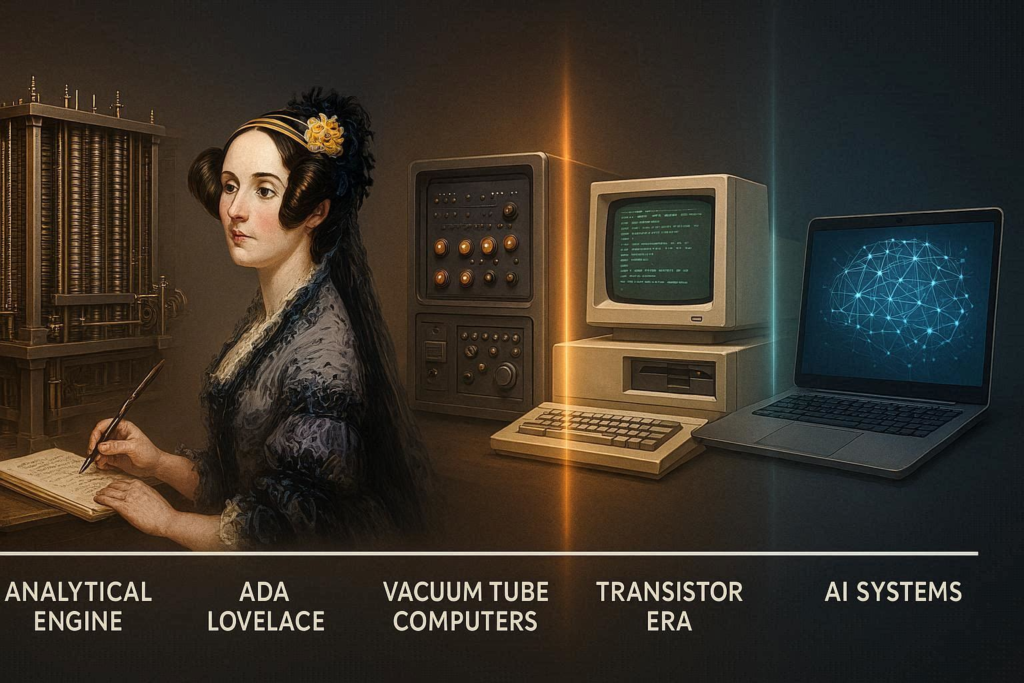
Ultimate histories of the modern computer begin with the Analytical Engine envisioned by
Charles Babbage following the mathematical ideas of George Boole, the mathematician who first
stated the principles of logic inherent in today’s digital computer. Babbage’s assistant and
collaborator, Ada Lovelace, is said to have introduced the ideas of program loops and
subroutines and is sometimes considered the first programmer. Apart from mechanical
calculators, the first really useable computers began with the vacuum tube, accelerated with the
invention of the transistor, which then became embedded in large numbers in integrated
circuits, ultimately making possible the relatively low-cost personal computer.
Modern computers inherently follow the ideas of the stored program laid out by John von
Neumann in 1945. Essentially, the program is read by the computer one instruction at a time,
an operation is performed, and the computer then reads in the next instruction, and so on.
Recently, computers and programs have been devised that allow multiple programs
(and computers) to work on the same problem at the same time in parallel. With the advent of
the Internet and higher bandwidth data transmission, programs and data that are part of the
same overall project can be distributed over a network and embody the Sun Microsystems
slogan: “The network is the computer.”
Technically, a computer is a programmable machine. This means it can execute a programmed
list of instructions and respond to new instructions that it is given. Today, however, the term is
most often used to refer to the desktop and laptop computers that most people use. When
referring to a desktop model, the term “computer” technically only refers to the computer itself – not the monitor, keyboard, and mouse. Still, it is acceptable to refer to everything together as
the computer. If you want to be really technical, the box that holds the computer is called the
“system unit.” MCA Semester 1 Study Routine 2026
Some of the major parts of a personal computer (or PC) include the motherboard, CPU, memory
(or RAM), hard drive, and video card. While personal computers are by far the most common
type of computers today, there are several other types of computers. For example, a
“minicomputer” is a powerful computer that can support many users at once. A “mainframe” is
a large, high-powered computer that can perform billions of calculations from multiple sources
at one time. Finally, a “supercomputer” is a machine that can process billions of instructions a
second and is used to calculate extremely complex calculations.
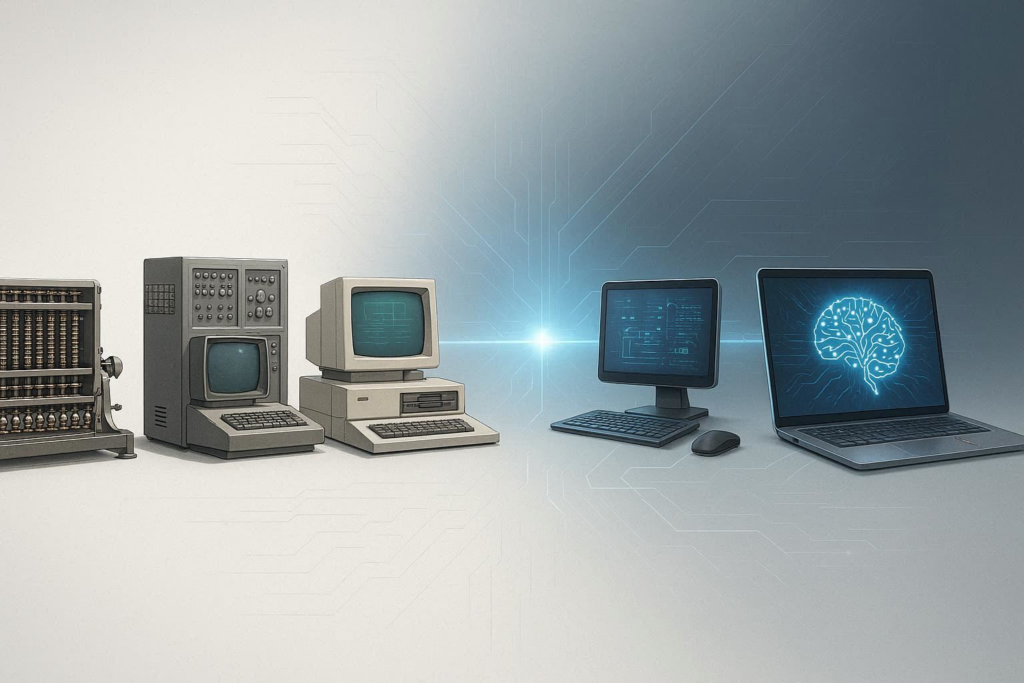
THE EVOLUTION OF COMPUTER
Since civilizations began, many of the advances made by science and technology have depended
upon the ability to process large amounts of data and perform complex mathematical
calculations. For thousands of years, mathematicians, scientists and businessmen have
searched for computing machines that could perform calculations and analyze data quickly and
efficiently. One such device was the abacus. MCA Semester 1 Study Routine 2026
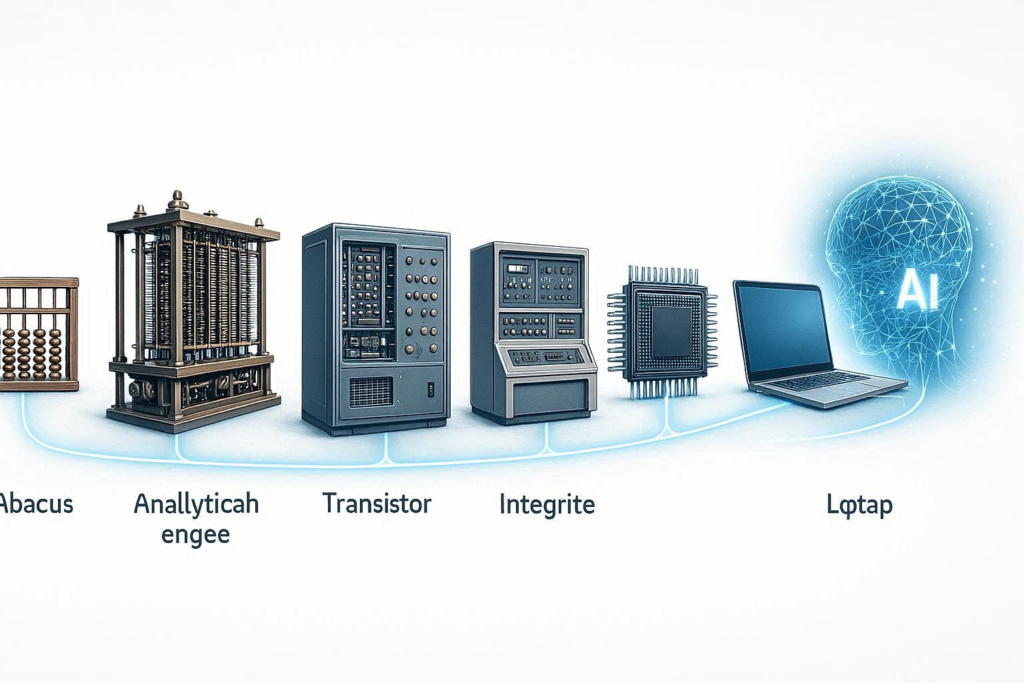
The abacus was an important counting machine in ancient Babylon, China, and throughout
Europe where it was used until the late middle ages. It was followed by a series of improvements
in mechanical counting machines that led up to the development of accurate mechanical adding
machines in the 1930’s. These machines used a complicated assortment of gears and levers to
perform the calculations but they were far to slow to be of much use to scientists. Also, a
machine capable of making simple decisions such as which number is larger was needed. A
machine capable of making decisions is called a computer.
The first computer like machine was the Mark I developed by a team from IBM and Harvard
University. It used mechanical telephone relays to store information and it processed data
entered on punch cards. This machine was not a true computer since it could not make
decisions.
In June 1943, work began on the world’s first electronic computer. It was built at the University
of Pennsylvania as a secret military project during World War II and was to be used to calculate
the trajectory of artillery shells. It covered 1500 square feet and weighed 30 tons. The project
was not completed until 1946 but the effort was not wasted. In one of its first demonstrations,
the computer solved a problem in 20 seconds that took a team of mathematicians three days.
This machine was a vast improvement over the mechanical calculating machines of the past
because it used vacuum tubes instead of relay switches. It contained over 17,000 of these tubes,
which were the same type tubes used in radios at that time. MCA Semester 1 Study Routine 2026
The invention of the transistor made smaller and less expensive computers possible. Although
computers shrank in size, they were still huge by today’s standards. Another innovation to
computers in the 60’s was storing data on tape instead of punch cards. This gave computers ability to store and retrieve data quickly and reliably. This series covers many of the major
milestones in computer history with a concentration on the history of personal home
computers.
CHARACTERITICS OF COMPUTER
Computers of all sizes have common characteristics – speed, arithmetical and logical operations,
accuracy, reliability, storage, retrieving data and programs, automation, versatility,
communications, diligence, feelings, consistency and precision. Computers are the foundation
of business, travel, and leisure life today. Computers provide the processing speed required by
all facets of society. The quick service we expect at the bank, at the grocery store, on the stock
exchange, and on the Internet are dependent on the speed of computers. Can you imagine our
world without computers?
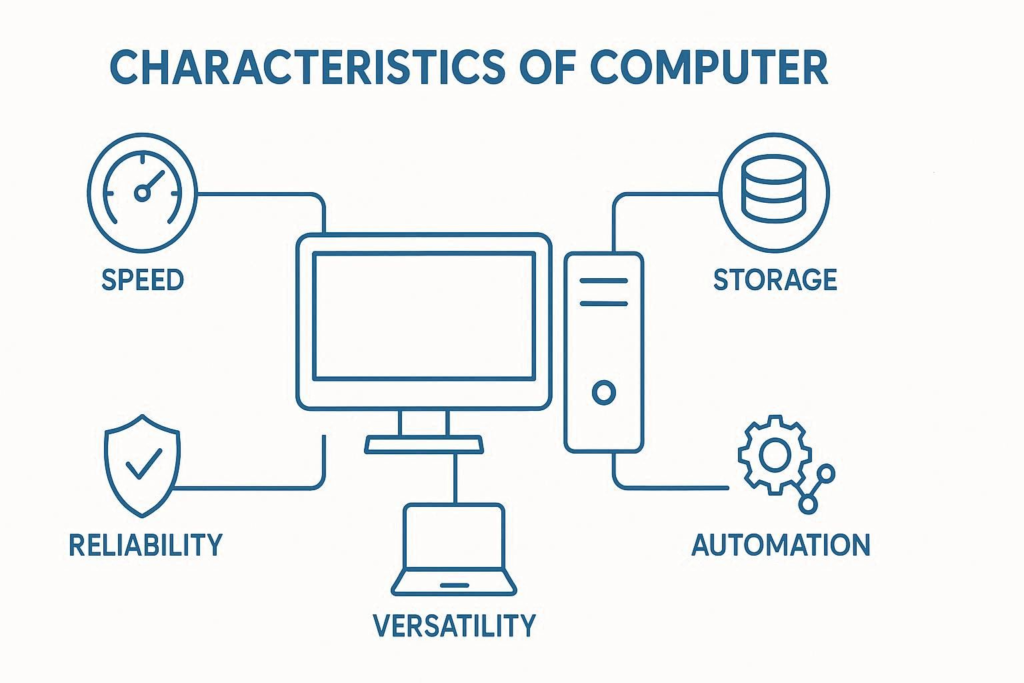
Computers are extremely reliable as well. Most errors are caused by humans, not computers.
Computers are capable of storing enormous amounts of data that must be located and retrieved very
quickly. The capability to store and retrieve volumes of data is at the core of the Information Age.
Now-a-days computer is playing a main role in everyday life it has become the need of people just
like television, telephone or other electronic devices at home. It solves the human problems very
quickly as well as accurately. The important characteristics of a computer are described below:
- Speed MCA Semester 1 Study Routine 2026
The computer is a very high speed electronic device. The operations on the data inside the
computer are performed through electronic circuits according to the given instructions. The
data and instructions flow along these circuits with high speed that is close to the speed of light.
Computer can perform millions of billions of operations on the data in one second. The computer
generates signals during the operation process therefore the speed of computer is usually
measure in megahertz (MHz) or Giga hertz (GHz). It means million cycles units of frequency is
hertz per second. Different computers have different speed.
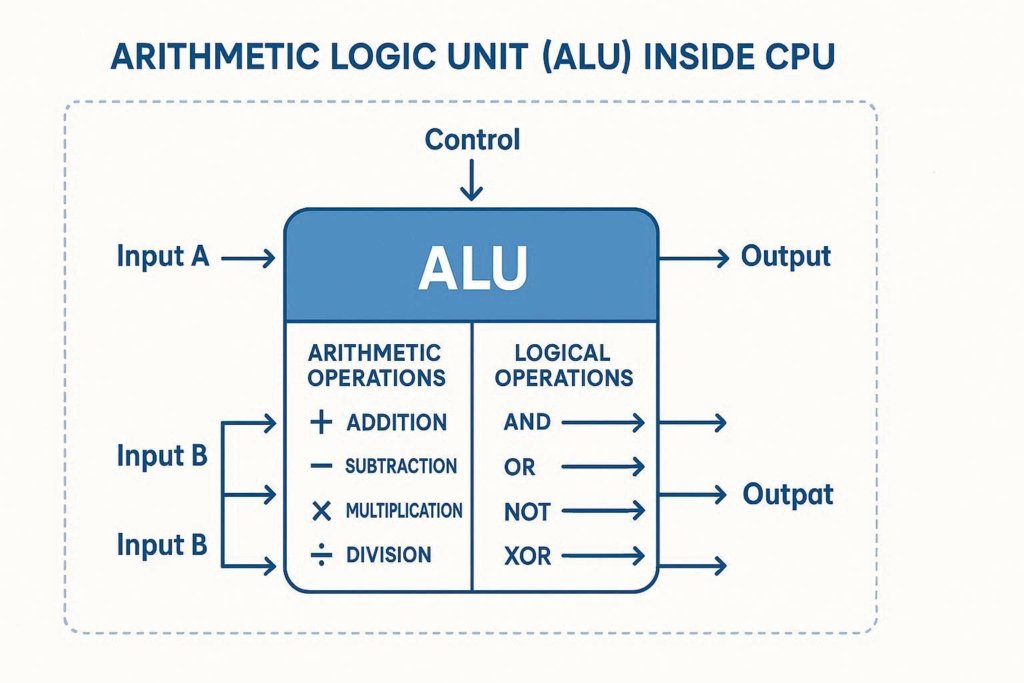
Arithmetical and Logical Operations
A computer can perform arithmetical and logical operations. In arithmetic operations, it
performs the addition, subtraction, multiplication and division on the numeric data. In logical
operation it compares the numerical data as well as alphabetical data.
2. Accuracy
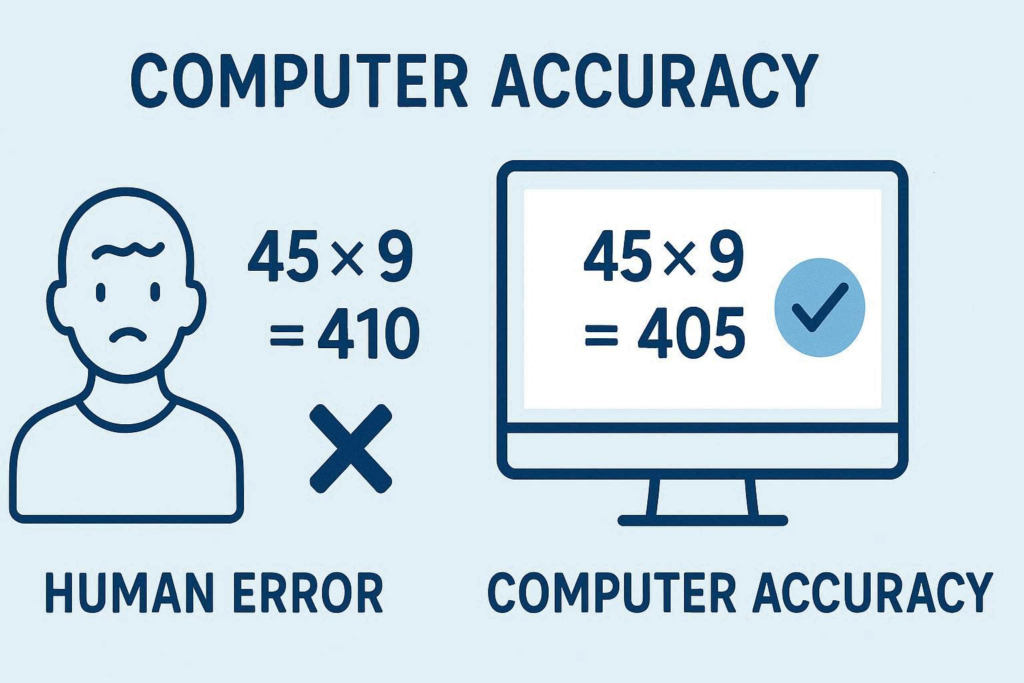
In addition to being very fast, computer is also very accurate device. It gives accurate output
result provided that the correct input data and set of instructions are given to the computer. It
means that output is totally depended on the given instructions and input data. If input data is
in-correct then the resulting output will be in-correct. In computer terminology it is known as
garbage-in garbage-out.
3. Reliability
The electronic components in modern computer have very low failure rate. The modern
computer can perform very complicated calculations without creating any problem and
produces consistent (reliable) results. In general, computers are very reliable. Many personal
computers have never needed a service call. Communications are also very reliable and
generally available whenever needed.
4. Storage
A computer has internal storage (memory) as well as external or secondary storage. In
secondary storage, a large amount of data and programs (set of instructions) can be stored for
future use. The stored data and programs are available any time for processing. Similarly
information downloaded from the internet can be saved on the storage media.
Retrieving data and programs
The data and program stored on the storage media can be retrieved very quickly for further
processing. It is also very important feature of a computer.
5. Automation
A computer can automatically perform operations without interfering the user during the
operations. It controls automatically different devices attached with the computer. It executes
automatically the program instructions one by one.
6. Versatility
Versatile means flexible. Modern computer can perform different kind of tasks one by one of
simultaneously. It is the most important feature of computer. At one moment you are playing
game on computer, the next moment you are composing and sending emails etc. In colleges and
universities computers are used to deliver lectures to the students. The talent of computer is
dependent on the software.
7. Communications
Today computer is mostly used to exchange messages or data through computer networks all
over the world. For example the information can be received or send through the internet with
the help of computer. It is most important feature of the modern information technology.
8. Diligence
A computer can continually work for hours without creating any error. It does not get tired while
working after hours of work it performs the operations with the same accuracy as well as speed at the first one.
9. Feelings
Computer is an electronic machine. It has no feelings. It detects objects on the basis of
instructions given to it. Based on our feelings, taste, knowledge and experience: we can make
certain decisions and judgments in our daily life. On the other hand, computer cannot make such
judgments on their own. Their judgments are totally based on instructions given to them.
10. Consistency
People often have difficulty to repeat their instructions again and again. For example, a lecturer
feels difficulty to repeat a same lecture in a class room again and again. Computer can repeat
actions consistently (again and again) without losing its concentration:
- To run a spell checker (built into a word processor) for checking spellings in a document.
- To play multimedia animations for training purposes.
- To deliver a lecture through computer in a class room etc.
- A computer will carry out the activity with the same way every time.
- You can listen a lecture or perform any action again and again.
11. Precision
Computers are not only fast and consistent but they also perform operations very accurately
and precisely. For example, in manual calculations and rounding fractional values (That is value
with decimal point can change the actual result). In computer however, you can keep the
accuracy and precision upto the level, you desire. The length calculations remain always
accurate.
5.ORGANIZATION OF A COMPUTER
A computer is a fast and accurate device, which can accept data, store data, process them and
give, desired results as output. The computer is organized into four units such as, Input unit, CPU,
Secondary memory and Output unit.
A hardware device that accepts inputted information and also has the capability of outputting
that information.
5.1 Input Unit
Any device designed to assist in the entry of data into a computer is known as Input device. Input
devices convert data from any convenient external format into binary codes that a computer can
store and manipulate internally. Some of the most common, most popularly used devices are
discussed below.
- Mouse:
This Input device is categorized as a pointing device because it is used to point and select an
option on the monitor. It is small boxlike object that is connected to the computer by a cable and
can be rolled around on the table. A pointer on the screen follows the movements of the mouse;
rolling the mouse left moves the pointer left by an equipment amount , rolling the mouse in the right direction moves the pointer in the right direction, rolling the mouse in the up direction moves
the pointer in the up direction, rolling the mouse in the down direction moves the pointer in the down
direction and you can roll the mouse in a angular direction also. In order to select an option on the
computer screen, the user should move the pointer at the desired position and press the button on
the mouse. The mouse can be used to open menus, select texts for editing, move objects on the
screen, draw images or diagrams etc.
A mouse can be classified on the basis of the number of buttons it has, the technology it uses, and
the kind of interface it shares with the computer. A mouse may have one, two or three buttons.
The program that uses the mouse determines the function of each button. A mouse may be
classified as a Mechanical mouse and an Optical mouse, on the basis of the technology it uses. In
a Mechanical mouse, the rubber-coated ball that projects through the bottom surface rotates as
the mouse is moved along a flat surface and sends electrical signals to the system unit by means
of switches inside the mouse. This causes the cursor, or pointer, to move in a corresponding
fashion. An Optical mouse uses diodes to emit light beam instead of a rotating ball to detect
movement across a specially patterned metal pad.
2. Light Pen:
This is also categorized into a pointing device, which can be used only with video displays. It can
be used to select an option by simply pointing at it, or drawing figures directly on the screen. An
electron beam that repeatedly scans the display screen from left to right and from top to bottom
produce a video display. Because of this scanning action, each point on the display is illuminated
at a slightly different time.
The light pen, which is a pen like device, has a photo detector at its tip. The detector can detect
changes in the brightness of the screen. The light pen is connected to the computer by a cable.
When the pen is pointed at a particular spot on the screen, the point is scanned and the photo
detector records changes in the brightness and sends electrical pulses to the computer. The
computer can find out the exact spot with this information. Light pens are useful for menu-based
applications. It is also useful for drawing graphics in Computer Aided Design software.
3. Touch Screen:
A type of display screen that has a touch-sensitive transparent panel covering the screen. Instead
of using a pointing device such as a mouse or light pen, you can use your finger to point directly
to objects on the screen.
Although touch screens provide a natural interface for computer novices, they are unsatisfactory
for most applications because the finger is such a relatively large object. It is impossible to point
accurately to small areas of the screen.
4. Joy Stick:
A lever that moves in all directions and controls the movement of a pointer or some other display
symbol. A joystick is similar to a mouse, except that with a mouse the cursor stops moving as
soon as you stop moving the mouse. With a joystick, the pointer continues moving in the direction
the joystick is pointing. To stop the pointer, you must return the joystick to its upright position.
Most joysticks include two buttons called triggers. Joysticks are used mostly for computer games,
but they are also used occasionally for CAD/CAM systems and other applications.
5. Keyboard:
Keyboards are the most widely used input devices. The most popular keyboards are those that
look, feel, and possibly sound like an ordinary typewriter keyboard. Alternatives are Membrane
keyboards, whose keys are merely printed on a plastic membrane. A pressure sensitive two
dimensional keyboard covered with a dust proofed and dirt proofed plastic sheet are useful in
dirty environments. Keyboards are of different varieties. Generally a keyboard has 105 keys. It features 12 function keys arranged at the top of the keyboard, and larger Backspace key, a
numeric keypad, a cursor movement keypad, toggle lights, Shift keys, Alt keys, Ctrl keys, Caps
Lock key, Num Lock key, Spacebar key, Enter key, Alphabetical keys etc.
6. Scanners:
These are the eyes of your computer. They can see images or printed text and translate them into
binary code. Most scanners collect data from a page by recording, which areas are light and which
areas are dark. They contain a camera, which is made up of thousands of tiny cells, called charge
coupled devices (CCD). Each CCD detects whether a small part of the image is either light or dark.
It transmits this data to the CPU, which then creates the image. Some scanners are sensitive
enough to tell the difference between colors.
Many scanners available nowadays are capable of not only scanning texts and graphics, but also
integrated text and graphic files. Scanners are used to reproduce photographs on the computer
screen. Businesses use scanners for storing documents on the computer.
7. Optical Character Readers (OCR):
These are another kind of input devices that are used to read any printed text. They can interpret
handmade marks, handwritten characters, machine printed characters and special symbols and
codes. Optical character readers scan text character-by-character converts them into machine-
readable codes and store it in the memory. Since they read characters at the rate of around 2600
characters per second this reduces the organizations the data inputting time.
8. Magnetic Ink Character Reader (MICR):
A magnetic character reader system for reading and identifying magnetized characters printed
on a document such as a check, in which analog waveforms derived from scanning the characters
are analyzed by rectifying and integrating the waveform to generate a value representing the
gain of a programmable gain amplifier for use in amplifying the waveform to compensate for
variations in ink intensity.
Means are provided for generating a value representing the center of gravity of the area under
each peak of the amplified waveform for use in retiming the peak sampling windows for
compensating for variations in the speed of the document past the magnetic read head. Digital
values representing the area under each peak curve in the waveform are compared with
corresponding values of a plurality of reference characters to identify the unknown character.
9. Bar Code Reader:
This is used to read different kind of vertical lines known as bars which signify some information.
10. Touch Pad
Most laptop computers today have a touch pad pointing device. You move the on-screen cursor
by sliding your finger along the surface of the touch pad. The buttons are located below the pad,
but most touch pads allow you to perform “mouse clicks” by tapping on the pad itself.
Touch pads have the advantage over mouse that they take up much less room to use. They have
the advantage over trackballs (which were used on early laptops) that there are no moving parts
to get dirty and result in jumpy cursor control.
11. Track Point
Some sub-notebook computers (such as the IBM ThinkPad), which lack room for even a touch
pad, incorporate a trackpoint, a small rubber projection embedded between the keys of the
keyboard. The trackpoint acts like a little joystick that can be used to control the position of the
on-screen cursor.
Graphics Tablet:
A graphics tablet consists of an electronic writing area and a special “pen” that works with it.
Graphics tablets allow artists to create graphical images with motions and actions similar to using
more traditional drawing tools. The pen of the graphics tablet is pressure sensitive, so pressing
harder or softer can result in brush strokes of different width (in an appropriate graphics
program).
Microphone:
A microphone can be attached to a computer to record sound (usually through a sound card input
or circuitry built into the motherboard). The sound is digitized – turned into numbers that
represent the original analog sound waves – and stored in the computer to later processing and
playback.
5.2 Central Processing Unit:
The central processing unit (CPU) is the electronic brain of the computer. The CPU in a personal
computer is usually a single chip. It organizes and carries out instructions that come from either
the user or from the software. The processor is made up of many components, but two of them
are worth mentioning at this point. These are the arithmetic and logic unit and the control unit.
The control unit controls the electronic flow of information around the computer. The arithmetic
logic unit, ALU, is responsible for mathematical calculations and logical comparisons.
The processor is plugged into the computer’s motherboard. The motherboard is a rigid
rectangular card containing the circuitry that connects the processor and all the other
components that make up your personal computer. In most personal computers, some of the
components are attached directly to the motherboard and some are housed on their own
small circuit boards that plug into the expansion slots built into the motherboard.
The processing capacity of a computer is measured in terms the amount of data processed by the