Best ChatGPT Prompt for Creating a Study Timetable
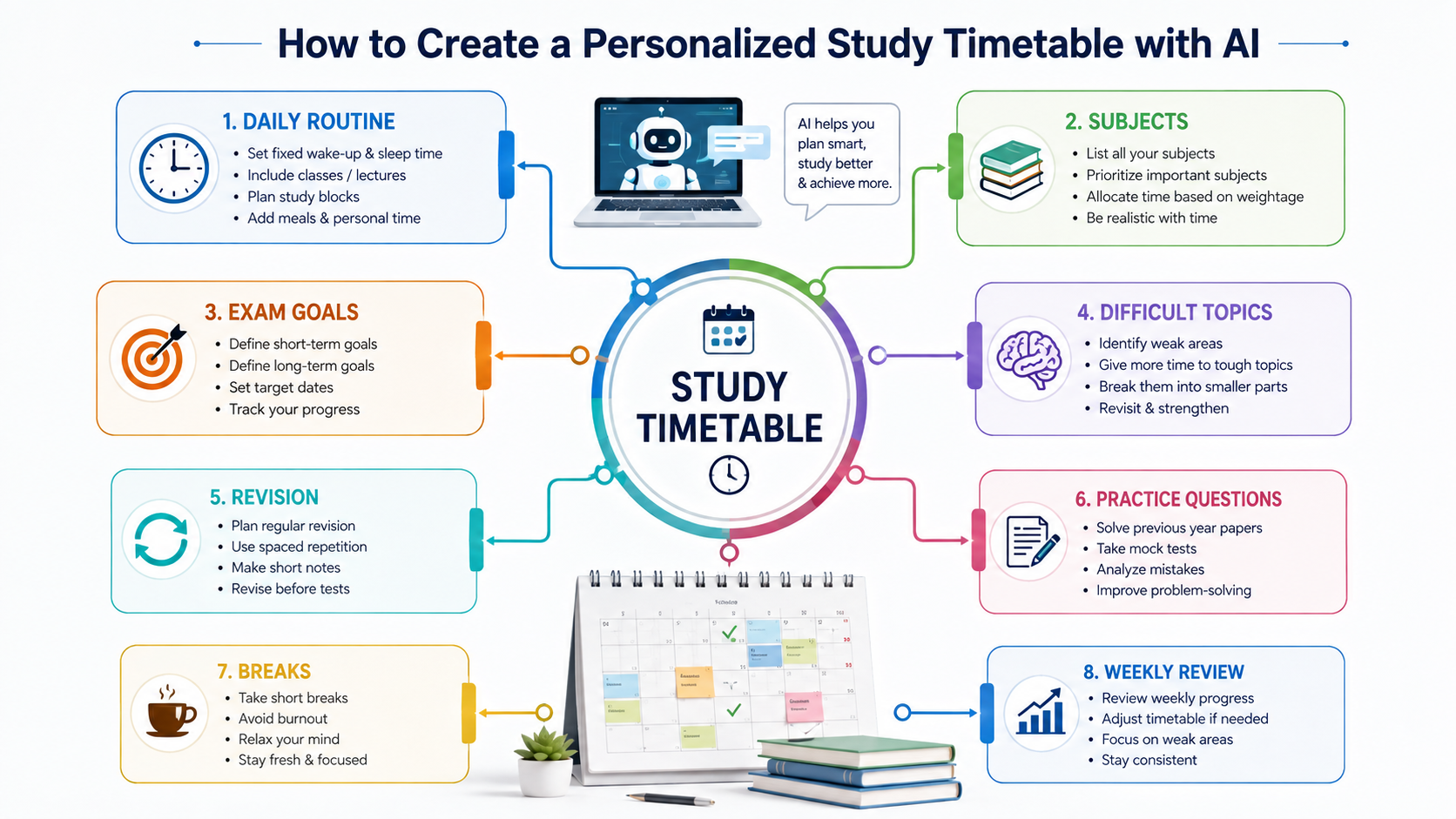
Creating a study timetable is one of the easiest ways to organize your study time, but making a timetable that you can actually follow is not always easy. Many students create a schedule with long study hours, too many subjects, and almost no breaks. After a few days, the timetable becomes difficult to maintain.
This is where ChatGPT can be useful.
With the right prompt, ChatGPT can help you create a personalized study timetable based on your subjects, exam dates, available study hours, difficult topics, daily routine, and preparation level. Instead of copying a general timetable from the internet, you can ask ChatGPT to create a schedule specifically for your needs. Best ChatGPT Prompt
Why Use ChatGPT for Creating a Study Timetable?
Every student’s routine is different. Some students have school or college during the day, while others may have coaching classes, homework, or other responsibilities.
A generic timetable may not work for everyone. Best ChatGPT Prompt
ChatGPT allows you to provide your own information and generate a timetable around it. You can tell ChatGPT how many hours you can study, which subjects are difficult, when your exams are scheduled, and how much of the syllabus you have already completed.
It can then help organize your study sessions into smaller and more manageable tasks.
For example, instead of simply writing “Study Mathematics for three hours,” you can create a plan such as mathematics concepts, problem-solving, revision, and practice questions.
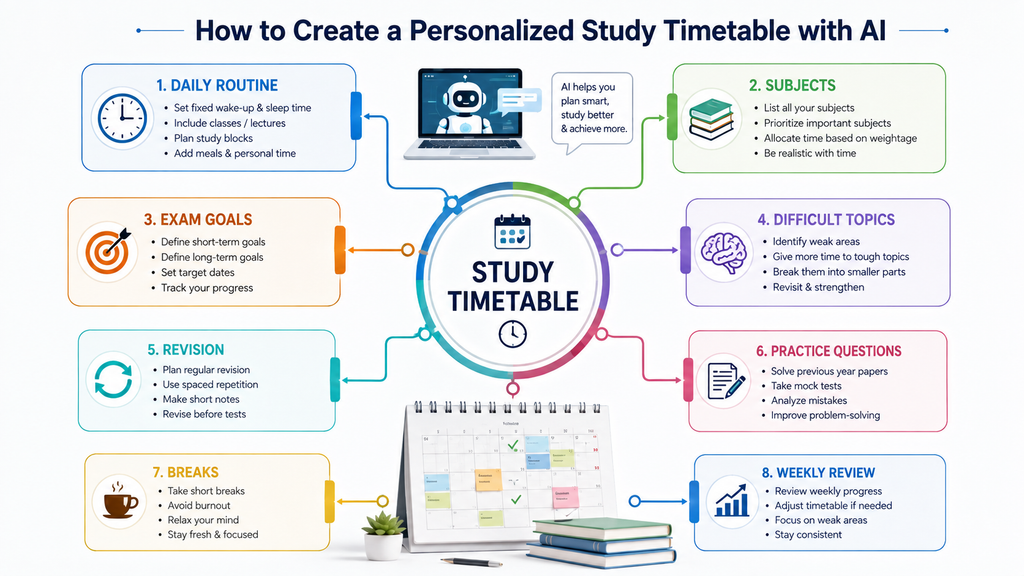
Simple Study Timetable Diagram Best ChatGPT Prompt
You can understand the basic structure of an effective study timetable through this simple diagram:
                 STUDY TIMETABLE
                       │
          ┌────────────┴────────────┐
          │                         │
      Daily Routine            Exam Goals
          │                         │
    ┌─────┼─────┐             ┌─────┴─────┐
    │     │     │             │           │
  Study  Break  Revision   Syllabus   Practice
    │                       │           │
    └──────────┬────────────┴───────────┘
               │
        Personalized Plan
               │
       ┌───────┴────────┐
       │                │
   Difficult         Easy Topics
    Subjects             │
       │                 │
       └────────┬────────┘
                │
          Weekly Review
The idea is simple: your timetable should connect your available time with your study goals. It should also include revision and breaks rather than focusing only on studying new topics.
Best ChatGPT Prompt for Creating a Study Timetable
Here is a ready-to-use prompt that students can copy and paste into ChatGPT:
Act as an expert study planner and create a realistic and personalized study timetable for me.
My class/grade: [Enter your class]
My subjects: [Enter all subjects]
Exam date: [Enter exam date]
School/college timing: [Enter timing]
Daily study time available: [Enter number of hours]
Difficult subjects: [Enter subjects]
Easy subjects: [Enter subjects]
Current preparation level: [Beginner/Intermediate/Advanced]
Homework or other responsibilities: [Enter details]
Preferred study time: [Morning/Afternoon/Evening/Night]Create a realistic timetable that balances learning new topics, revision, practice questions, and breaks. Give more study time to difficult and high-priority subjects. Avoid creating an unrealistic schedule.
Show the timetable in a simple table with the day, time, subject, and specific task. Include weekly revision, practice questions, and at least one test or self-assessment session. Also give me five practical tips to follow the timetable consistently.
This prompt gives ChatGPT enough information to understand your routine and create a more useful study plan.
How to Make the Prompt More Personalized
The quality of the timetable depends heavily on the information you provide.
For example, simply saying “I have five subjects” may not be enough. Instead, mention which subjects are difficult for you and which ones you are already comfortable with.
You can also mention how much time you have available every day.
For example:
“I can study for three hours on weekdays and five hours on weekends.”
You can also tell ChatGPT about your exam dates:
“My exams start in 30 days. I have completed around half of my syllabus.”
This information allows the timetable to focus on completing the remaining syllabus while keeping enough time for revision.
ChatGPT Prompt for a Daily Study Timetable
Sometimes you don’t need a timetable for an entire month. You may simply want a schedule for today.
Try this prompt:
Create a realistic study timetable for today. I have 4 hours available for studying. My subjects are Mathematics, Science, English, and Social Science. Mathematics and Science need more attention. I also need to revise yesterday’s topics. Divide the four hours into focused study sessions with short breaks. Include specific tasks instead of simply listing the subjects.
This type of prompt can be especially useful when you have a busy or changing schedule.
ChatGPT Prompt for Exam Preparation
If your exams are approaching, you can make the prompt more detailed:
Create a 30-day exam preparation timetable for me. I have five subjects and my exams begin after 30 days. Divide the syllabus into daily tasks. Give additional time to difficult subjects and include revision after completing important topics. Reserve the final days for revision, practice questions, and mock tests. Make the timetable realistic and include appropriate breaks and sleep time.
Instead of looking at the entire syllabus as one huge task, you can break it into smaller daily goals.
Example of a Simple Study Schedule

| Time | Activity |
|---|---|
| 5:00–5:50 PM | Mathematics – New Topic |
| 5:50–6:05 PM | Short Break |
| 6:05–6:55 PM | Science – Concept Learning |
| 6:55–7:10 PM | Break |
| 7:10–8:00 PM | English – Reading/Writing |
| 8:00–8:20 PM | Dinner/Rest |
| 8:20–9:00 PM | Revision + Practice Questions |
Suppose a student has four hours available in the evening. A balanced schedule might look like this:
The exact timings can change according to the student’s routine. The important thing is to create a schedule that is realistic and leaves enough time for rest.
Ask ChatGPT to Improve Your Existing Timetable
You don’t always need to create a timetable from scratch.
If you already have a timetable but are struggling to follow it, give it to ChatGPT and ask:
Review my current study timetable and identify what makes it difficult to follow. Then create an improved version with better time distribution, realistic study sessions, revision periods, and breaks. Keep my important daily commitments unchanged.
This can help turn an overly complicated schedule into something more practical.
Tips for Following Your Study Timetable
A timetable is useful only when you can actually follow it. Don’t fill every minute of the day with study sessions. Leave some flexibility for unexpected tasks.
Start with realistic study goals. Completing three focused tasks is often more useful than creating a huge list that you cannot finish.
Revision should also be included regularly. Don’t wait until the day before an exam to revise everything.
Another useful habit is to review your timetable at the end of each week. Ask yourself which tasks were completed and which ones need more time. You can then adjust the following week’s schedule.
Most importantly, don’t worry if you miss one study session. Simply adjust your schedule and continue with the next task.
Final Thoughts
Creating a good study timetable doesn’t mean studying all day. It means using your available time in a smart and organized way.
ChatGPT can make this process easier by creating a personalized schedule based on your subjects, exam dates, available time, difficult topics, and daily responsibilities. The key is to give ChatGPT detailed information instead of using a very short and generic prompt.
The Best ChatGPT Prompt for Creating a Study Timetable can be customized for daily study, weekly planning, or complete exam preparation. You can also ask ChatGPT to improve your existing schedule whenever your routine changes.
Try the prompt above, add your own details, and create a study timetable that fits your actual life not just a timetable that looks good on paper.