The Shocking True Story Behind St Andrew’s Day: Scotland’s National Day Explained (2026)
Introduction
St Andrew’s Day is celebrated every year on 30 November and is one of the most important dates in Scotland’s cultural calendar. It honours Saint Andrew, Scotland’s patron saint, while also celebrating Scottish heritage, music, dancing, food and national identity.
But the story behind St Andrew’s Day is older and more fascinating than a modern celebration. The connection between Saint Andrew and Scotland involves centuries of religious tradition, Scottish history and national symbolism, including the famous Saltire, Scotland’s blue-and-white flag.
In 2026, St Andrew’s Day falls on Monday, 30 November, giving people another opportunity to celebrate Scottish culture through traditional events, ceilidhs, music, food and community gatherings. In this guide, we’ll explore the history behind the day and share 10 realistic St Andrew’s Day AI image prompts inspired by Scotland’s landscapes, heritage, traditions and celebrations.
What Is St Andrew’s Day?
St Andrew’s Day is Scotland’s national day, celebrated every year on 30 November in honour of Saint Andrew, the patron saint of Scotland. The day is closely connected with Scottish identity, heritage and traditions, and celebrations can include music, dancing, food, cultural events and gatherings with family and friends.
Although St Andrew’s Day has religious origins, its modern meaning is much broader. For many people, it is an opportunity to celebrate Scottish culture and heritage, whether through traditional music, a ceilidh, Scottish food, historic places or the display of the Saltire.
The date also has strong symbolic importance because Saint Andrew has been associated with Scotland for centuries. His image and the famous diagonal white cross connected with him have become important parts of Scottish national identity.
When Is St Andrew’s Day in 2026?
St Andrew’s Day falls on 30 November every year. In 2026, St Andrew’s Day will be celebrated on Monday, 30 November.
Across Scotland, the occasion can be marked through cultural events, traditional music, ceilidh dancing, food, community gatherings and activities celebrating Scottish history and heritage. The exact way people celebrate varies between communities and locations.
The Scottish Government also recognizes 30 November in its official calendar and provides guidance concerning the display of the Saltire on St Andrew’s Day.
Who Was Saint Andrew?
Saint Andrew was one of the Twelve Apostles of Jesus and is traditionally described as the brother of Saint Peter. Christian tradition identifies Andrew as one of the earliest followers of Jesus.
His connection with Scotland developed through centuries of religious tradition and historical symbolism. He eventually became recognized as Scotland’s patron saint, and his name became closely connected with the country and the city of St Andrews in Fife.
Today, Saint Andrew is remembered not only as an important Christian figure but also as a central symbol of Scottish heritage and national identity.
The Story and Tradition Behind Saint Andrew
The connection between Saint Andrew and Scotland contains both historical evidence and long-standing tradition.
One important tradition tells of Saint Andrew’s relics being brought to Scotland, with the site that later became St Andrews becoming associated with him. The historic remains of St Andrews Cathedral and St Rule’s Tower are closely connected with this tradition.
Another famous part of the story concerns the Saltire, the diagonal white cross on Scotland’s blue flag. Tradition connects this design with the cross associated with Saint Andrew.
It is important to separate these traditions from firmly documented historical facts. Some elements of the story developed through medieval tradition and religious storytelling rather than through evidence that can be independently verified. Nevertheless, these traditions became deeply influential in Scottish culture.
How Did Saint Andrew Become Scotland’s Patron Saint?
Saint Andrew’s association with Scotland developed over a long period rather than through a single event.
By the medieval period, Saint Andrew had become strongly established as Scotland’s patron saint. His importance can also be seen in historical Scottish documents. The Declaration of Arbroath of 1320, one of Scotland’s most famous medieval documents, refers to Saint Andrew as Scotland’s patron saint.
The association helped give Scotland a distinctive religious and cultural symbol. Over time, Saint Andrew’s name became connected with Scottish churches, places, traditions and national celebrations.
This long history is one reason St Andrew’s Day remains significant today. It connects modern celebrations with centuries of Scottish religious and cultural heritage.
Why Is the Scottish Flag Connected to St Andrew?
The Scottish flag is known as the Saltire. It features a white diagonal cross against a blue background and is one of the most recognizable symbols of Scotland.
The diagonal cross is traditionally associated with the cross of Saint Andrew. According to Scottish tradition, this connection helped establish the Saltire as a national symbol.
Today, the Saltire can be seen across Scotland during national celebrations, sporting events, cultural festivals and other occasions connected with Scottish identity.
What Is the Saltire?
The Saltire is the national flag of Scotland. Its most recognizable feature is the white diagonal cross extending across a blue field.
The design is traditionally connected with Saint Andrew and his association with an X-shaped cross. While the historical development of the flag involves tradition and symbolism from different periods, the Saltire is now firmly established as one of Scotland’s most important national emblems.
On St Andrew’s Day, the Saltire has particular significance because it visually connects Scotland’s national identity with its patron saint.
St Andrew’s Day Traditions in Scotland
St Andrew’s Day celebrations can vary widely, but many events focus on Scottish music, dancing, food and community.
Modern celebrations may take place in community halls, schools, cultural venues, public spaces and private homes. Some events are formal, while others are simply gatherings where people enjoy Scottish traditions together.
Scottish Music and Bagpipes
Scottish music is an important part of many cultural celebrations, and bagpipes are among the instruments most strongly associated with Scottish heritage.
During St Andrew’s Day events, traditional Scottish music may be performed by individual musicians, pipe bands or groups. Bagpipe performances can add a strong sense of ceremony to public celebrations and cultural events.
Scottish music is not limited to bagpipes, however. Fiddle music, traditional songs and other forms of Scottish folk music can also form part of cultural celebrations.
Ceilidh Dancing
A ceilidh is a traditional Scottish social gathering that often includes music and dancing. Today, ceilidh events are a popular way to bring people together for Scottish cultural celebrations.
St Andrew’s Day ceilidhs can feature group dances led by live musicians, with participants following simple dance instructions. The atmosphere is usually social and energetic rather than focused on professional dancing.
For visitors and people unfamiliar with Scottish traditions, a ceilidh can also be an accessible way to experience Scottish culture as part of a community celebration.
Traditional Scottish Food
Food can also play a role in St Andrew’s Day gatherings, although there is no single official menu that everyone must follow.
Traditional Scottish dishes and ingredients may be included at celebrations, depending on the event and region. Foods associated with Scottish cuisine can include haggis, neeps and tatties, Cullen skink, shortbread and other traditional dishes.
The important point is that St Andrew’s Day food traditions are flexible. Some people may prepare a traditional Scottish meal, while others may simply include Scottish-inspired dishes as part of a larger celebration.
10 St Andrew’s Day AI Image Prompts for 2026
Create realistic, cinematic and culturally authentic images inspired by Scottish history, landscapes, traditions, heritage and modern St Andrew’s Day celebrations. Each prompt uses a different setting, composition, lighting style and creative direction so the results do not look repetitive.
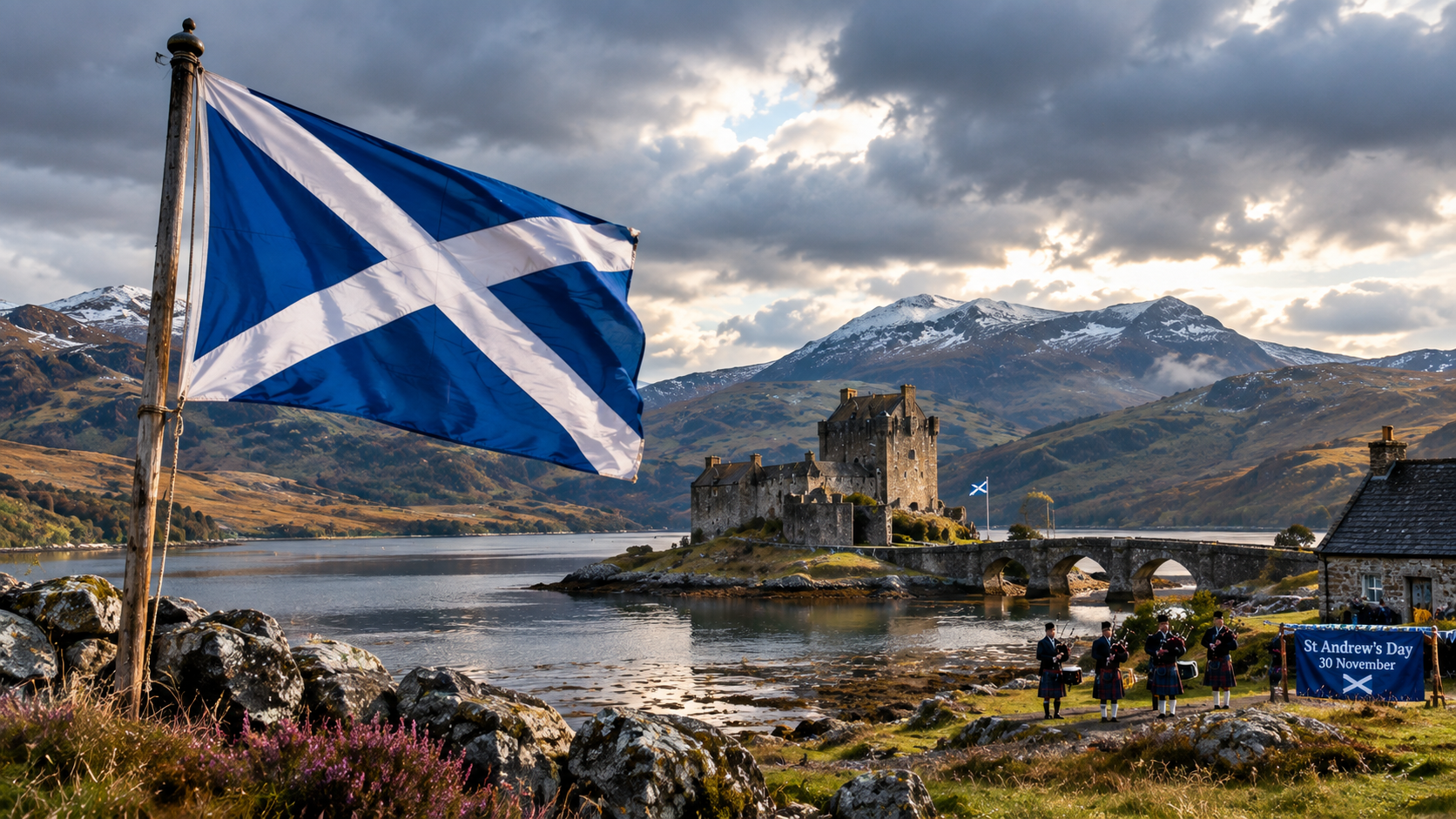
1 Cinematic Scottish Landscape
A dramatic Scottish landscape creates a strong opening image for St Andrew’s Day, combining natural scenery with national symbolism.

Create a photorealistic cinematic St Andrew’s Day scene in the Scottish Highlands, with rugged green mountains, a calm loch, ancient stone buildings in the distance and a large Scottish Saltire flag moving naturally in the cool November wind. Overcast dramatic sky with soft breaks of sunlight, authentic Scottish landscape, realistic textures, natural atmospheric depth, documentary photography style, balanced composition, subtle St Andrew’s Day celebration atmosphere, highly detailed environment, realistic lighting, vertical 2:3 composition.
2 Saint Andrew Historical Portrait
This concept focuses on Saint Andrew in a respectful historical setting rather than a modern celebration.
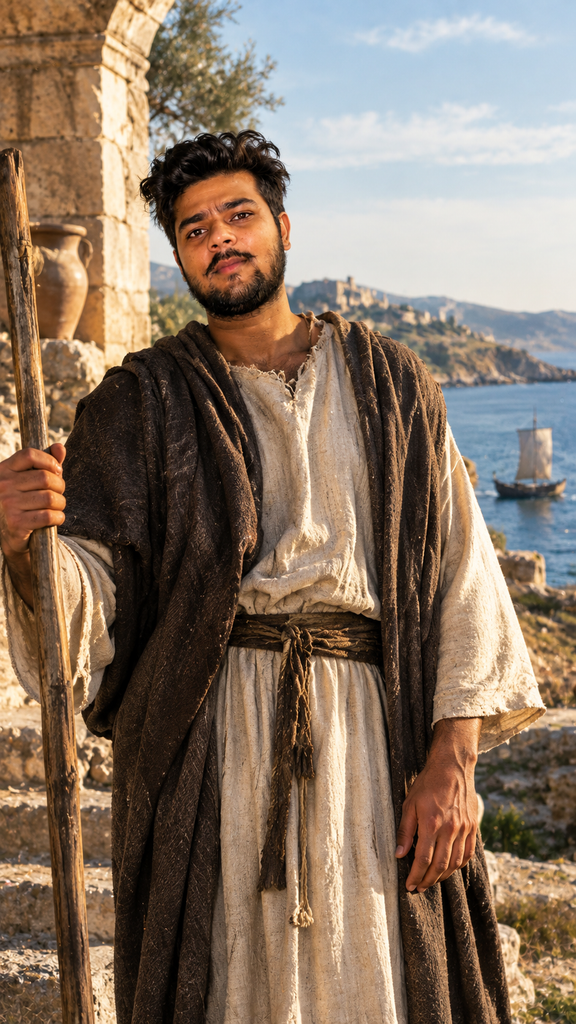
Create a historically inspired cinematic portrait of Saint Andrew standing in an ancient first-century Mediterranean setting, wearing simple historically appropriate robes, natural facial features, weathered realistic fabric, calm thoughtful expression, stone architecture and distant coastline behind him, warm natural sunlight, historically grounded atmosphere, realistic human proportions, detailed skin texture, subtle cinematic shadows, documentary-style historical photography aesthetic, vertical 2:3 composition.
3 The Saltire at a Historic Scottish Castle
The Saltire becomes the main visual symbol while the castle establishes Scottish heritage.
Create a photorealistic St Andrew’s Day scene featuring a large Scottish Saltire flying beside a historic stone castle in Scotland, rugged stone walls, mist-covered hills, late November atmosphere, soft cold daylight, wet stone textures after light rain, natural wind movement in the flag, authentic Scottish architecture, cinematic wide-angle perspective, realistic environmental details, dramatic but natural atmosphere, vertical 2:3 composition.
4 Traditional Scottish Ceilidh
This prompt captures the social and musical atmosphere of a Scottish celebration.
Create a realistic Scottish ceilidh celebration during St Andrew’s Day, with people performing traditional group dancing inside a historic community hall, musicians playing traditional Scottish instruments, authentic Scottish clothing, wooden floor, warm hanging lights, joyful but natural expressions, realistic movement and body proportions, detailed interior textures, documentary event photography style, cinematic evening lighting, culturally authentic atmosphere, vertical 2:3 composition.
5 Bagpiper and the Saltire
A lone bagpiper creates a strong editorial-style Scottish image.
Create a cinematic portrait of a traditional Scottish bagpiper standing outdoors beside a large Saltire flag on St Andrew’s Day, authentic Scottish formal attire, historic stone street in the background, cool November morning, soft directional daylight, realistic fabric and tartan textures, natural posture, detailed bagpipes, subtle wind movement, shallow but natural depth of field, editorial documentary photography, realistic skin and environmental texture, vertical 2:3 composition.
6 Historic St Andrews Heritage Scene
This image connects the celebration to the historic town associated with Saint Andrew.
Create a photorealistic historical-inspired view of St Andrews, Scotland, featuring ancient stone ruins, medieval architectural details and a quiet historic street decorated subtly with Scottish flags for St Andrew’s Day. Cool November atmosphere, cloudy sky, realistic aged stone textures, natural soft daylight, authentic Scottish heritage setting, cinematic architectural photography, balanced perspective, restrained colors, highly detailed environment, vertical 2:3 composition.
7 Scottish Food Celebration
Food adds a warm and human element to the cultural theme.
Create a realistic St Andrew’s Day Scottish dining table prepared for a traditional celebration, featuring authentic Scottish-inspired dishes, rustic ceramic plates, warm bread, seasonal ingredients, traditional tableware and subtle Saltire decorations. Cozy Scottish dining room, warm natural window light mixed with soft candlelight, realistic food textures, natural shadows, elegant but authentic styling, editorial food photography, detailed wooden table surface, vertical 2:3 composition.
8 Modern Edinburgh St Andrew’s Day Celebration
This prompt combines modern Scotland with traditional national symbolism.
Create a photorealistic modern St Andrew’s Day celebration in Edinburgh, Scotland, with historic city architecture illuminated during an evening celebration, people gathered naturally in the streets, Scottish flags displayed respectfully, subtle festive lighting, November evening atmosphere, realistic wet pavement reflections, authentic urban details, cinematic street photography, natural human proportions and expressions, realistic architecture, sophisticated editorial composition, vertical 2:3 format.
9 Scottish Highlands Celebration
A wider landscape scene can work especially well for Pinterest.
Create an epic but realistic St Andrew’s Day celebration in the Scottish Highlands, with a small group of people gathered near a historic stone structure overlooking dramatic mountains and a misty valley. Scottish flags moving gently in the wind, authentic outdoor clothing suitable for late November, natural cloudy daylight, atmospheric mountain mist, realistic terrain and vegetation, cinematic landscape photography, strong foreground and background depth, authentic Scottish cultural atmosphere, vertical 2:3 composition.
10 Elegant St Andrew’s Day Editorial Portrait
This final concept provides a polished modern interpretation of Scottish heritage.

Create a sophisticated editorial portrait inspired by St Andrew’s Day, featuring a person wearing elegant traditional Scottish-inspired formal clothing with subtle tartan details, standing against an atmospheric historic Scottish stone building. Natural facial features, realistic skin texture, authentic clothing materials, soft November daylight, restrained Scottish heritage styling, cinematic editorial photography, realistic proportions, natural pose, detailed architectural background, premium magazine aesthetic without excessive retouching, vertical 2:3 composition.
Why These St Andrew’s Day AI Images Work
These St Andrew’s Day AI image prompts are designed around different aspects of Scottish history and culture rather than repeating the same visual idea. The collection moves from dramatic Highland landscapes and historic castles to Saint Andrew, the Saltire, ceilidh dancing, bagpipes, traditional food and modern Edinburgh celebrations.
Each prompt also uses a different visual direction, including landscape photography, historical portraiture, architectural photography, documentary-style events, editorial portraits and food photography. This variation helps create a more diverse collection of images for blog posts, Pinterest graphics, social media content and seasonal projects.
The prompts also focus on believable Scottish environments, natural lighting, authentic clothing and recognizable cultural details. Instead of relying only on dramatic effects or generic “cinematic” wording, they give the AI specific locations, settings, compositions and visual elements to work with.
How to Create More Realistic St Andrew’s Day AI Images
For more convincing results, the most important factor is specificity. Instead of asking an AI image generator for a generic Scottish celebration, describe the environment, architecture, clothing, lighting and atmosphere you want to see.
- Use specific Scottish locations, landscapes or architectural settings when appropriate.
- Describe natural lighting such as November daylight, cloudy skies, sunset or warm interior lighting.
- Include realistic clothing, fabric textures, architecture and environmental details.
- Avoid adding unnecessary “8K,” “ultra HD” or repeated quality terms to every prompt.
- Use different camera perspectives and compositions so every generated image feels visually distinct.
- When using a reference photo, ask the AI to preserve recognizable identity, natural facial features and realistic body proportions.
- Keep Scottish cultural elements authentic instead of combining unrelated stereotypes or decorative elements.
St Andrew’s Day: History, Tradition and Legend
The story of St Andrew’s Day combines documented Scottish history with religious tradition and legends that developed over many centuries.
Saint Andrew is traditionally recognized as Scotland’s patron saint, and his association with the country became particularly important during the medieval period. The Declaration of Arbroath of 1320 also refers to Saint Andrew as Scotland’s patron saint, showing how established the association had become by that time.
Other parts of the story, including traditions surrounding Saint Andrew’s relics and the origins of the Saltire, belong more to historical tradition and legend. These stories have nevertheless played an important role in shaping Scottish cultural identity.
Understanding the difference between documented history and traditional stories makes the subject more interesting. St Andrew’s Day is not based on one single event but reflects centuries of religious symbolism, Scottish history and evolving cultural traditions.
St Andrew’s Day in 2026
St Andrew’s Day will take place on Monday, 30 November 2026.
Scottish communities can mark the occasion in many different ways. Celebrations may include traditional Scottish music, ceilidh dancing, cultural performances, community gatherings, food events and activities focused on Scottish history and heritage.
The Saltire is also an important symbol during the occasion. The Scottish Government recognizes 30 November as St Andrew’s Day and provides official guidance concerning the display of the Saltire.
For visitors, Scottish communities and people interested in Scottish culture around the world, St Andrew’s Day provides an opportunity to explore the country’s traditions while also appreciating the historical story behind its national symbols.
Frequently Asked Questions
What is St Andrew’s Day?
St Andrew’s Day is Scotland’s national day, celebrated annually on 30 November in honour of Saint Andrew, the patron saint of Scotland. Modern celebrations often focus on Scottish culture, music, dancing, food and heritage.
When is St Andrew’s Day in 2026?
St Andrew’s Day is on Monday, 30 November 2026.
Why is Saint Andrew Scotland’s patron saint?
Saint Andrew became associated with Scotland through centuries of Christian tradition and Scottish history. By the medieval period, he was firmly established as Scotland’s patron saint, and the association is also referenced in the Declaration of Arbroath of 1320.
What is the Saltire?
The Saltire is the national flag of Scotland. It features a white diagonal cross on a blue background and is traditionally associated with Saint Andrew and the cross connected with him.
How do people celebrate St Andrew’s Day?
Celebrations vary, but may include Scottish music, bagpipe performances, ceilidh dancing, traditional food, cultural events, community gatherings and activities celebrating Scottish heritage.
Is St Andrew’s Day a public holiday in Scotland?
St Andrew’s Day is recognized as a bank holiday in Scotland, but a bank holiday does not automatically mean that everyone receives a day off work. Employers and organizations can have their own arrangements.
What are popular St Andrew’s Day traditions?
Popular celebrations can include ceilidh dancing, Scottish music, bagpipe performances, traditional food, cultural gatherings and events celebrating Scotland’s history and heritage.
useful for historical information about Saint Andrew, St Andrews Cathedral, the Saltire and Scotland’s heritage.
Conclusion
St Andrew’s Day is much more than a date on Scotland’s calendar. It brings together centuries of history, national identity, religious tradition and Scottish cultural heritage. The Saltire, traditional music, ceilidh dancing, historic architecture, Scottish landscapes and community celebrations all contribute to the modern meaning of the day.
For AI image creators, St Andrew’s Day also offers a wide range of authentic visual possibilities. From misty Highland landscapes and medieval architecture to bagpipers, ceilidhs and modern Edinburgh celebrations, each scene can tell a different part of Scotland’s story.
The 10 prompts in this guide are designed to create visually varied and realistic St Andrew’s Day images while keeping the Scottish setting and cultural details believable..
20 Guy Fawkes Night AI Photo Prompts 2026 for Cinematic Bonfire & Firework Photos